Above the Clouds and Beyond Convention: How America's Elite Are Rewriting the Rules of Air Travel
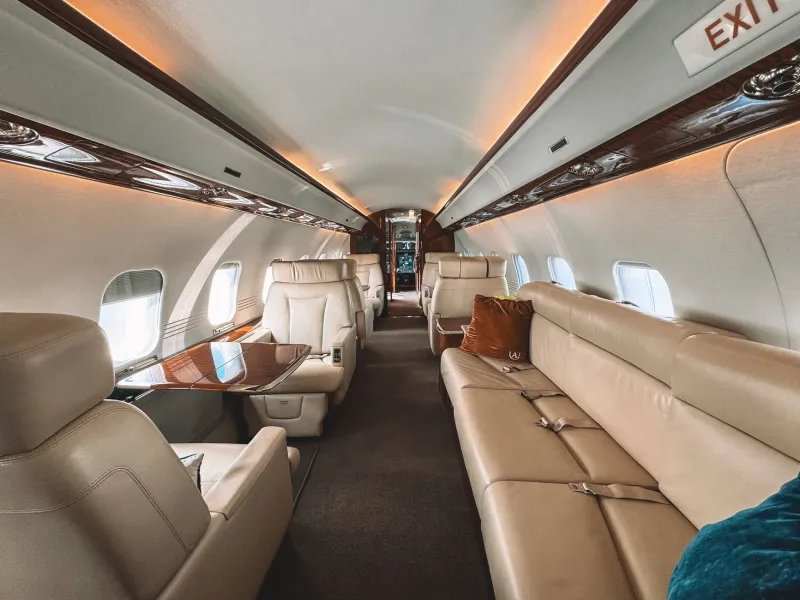
There is a moment, familiar to any seasoned private aviation passenger, that no first-class suite aboard a commercial carrier can replicate. It occurs somewhere between the seamless curbside arrival at a fixed-base operator — no queues, no security theater, no ambient chaos — and the instant the cabin door seals behind you, cocooning you in a world engineered entirely around your preferences. At that moment, the concept of "flying" is fundamentally renegotiated.
For a growing segment of ultra-high-net-worth Americans, that renegotiation is no longer an occasional indulgence. It is the standard. And the industry built to serve them has evolved into something remarkably sophisticated.
The Fractional Ownership Model: Equity in the Sky
Fractional jet ownership has matured considerably since NetJets first introduced the concept to American executives in the 1980s. Today, programs offered by operators such as NetJets, Flexjet, and Wheels Up have become the preferred entry point for travelers who require consistent, guaranteed access without absorbing the full capital and operational burden of outright aircraft ownership.
Under a fractional arrangement, a participant purchases a share — typically expressed as a fraction of annual flight hours, beginning at 50 hours — in a specific aircraft category. In exchange, they receive guaranteed availability, usually within four to ten hours of request, along with the operational infrastructure of a large fleet. The aircraft assigned on any given day may not be the precise tail number owned, but it will conform to the contracted category and standard.
The financial calculus is nuanced. Beyond the initial acquisition cost, which can range from several hundred thousand dollars for a light jet share to multiple millions for a large-cabin share, owners bear monthly management fees and occupied hourly rates. When aggregated, the total annual cost of a 100-hour fractional share in a super-midsize category aircraft frequently exceeds $500,000. For those who fly fewer than 150 hours annually, this model often delivers superior value — and considerably greater peace of mind — compared to whole aircraft ownership.
Charter: The On-Demand Philosophy
For travelers whose schedules resist predictability, on-demand charter presents a compelling alternative. Rather than committing capital to ownership, charter clients pay for access on a transactional basis, engaging operators through brokers, membership programs, or direct relationships with Part 135 certificate holders.
The charter market in the United States is extraordinarily deep. From turboprops suited to regional hops between Nantucket and Manhattan to ultra-long-range aircraft capable of connecting Los Angeles to Tokyo without a fuel stop, the available inventory accommodates virtually any mission profile. Card and membership programs — among them Sentient Jet, VistaJet's Private World program, and Airshare — offer pre-purchased hour blocks that simplify the booking process and provide rate predictability.
What distinguishes the finest charter experiences from the merely adequate is the degree of personalization that operators are willing to extend. The most respected brokers maintain detailed preference profiles for their clients: preferred cabin temperature, dietary requirements, reading material, floral arrangements, and even the specific vintage of Champagne to be chilled before boarding. These details, invisible in their execution, constitute the difference between transportation and an experience.
The Cabin as Personal Sanctuary
Modern large-cabin and ultra-long-range aircraft — the Gulfstream G700, Bombardier Global 7500, and Dassault Falcon 10X among them — offer interiors that rival the finest hotel suites in their appointments. Lie-flat beds with genuine mattresses and high-thread-count linens, full shower facilities, conference configurations that support meaningful productivity, and entertainment systems calibrated to audiophile standards are no longer remarkable features. They are expected ones.
Where bespoke operators truly distinguish themselves is in the layering of experiences that extend beyond hardware. Consider the growing trend of in-flight culinary programming: rather than pre-loaded catering, certain operators now partner with Michelin-recognized chefs to design menus specific to a client's itinerary and palate. A flight from Teterboro to Aspen might feature a coursed tasting menu of Colorado-inspired cuisine, prepared fresh and plated with the same attention one would expect at a destination restaurant.
Wellness integration has similarly become a priority. Operators are increasingly accommodating requests for in-flight fitness equipment, curated supplement regimens, sleep optimization protocols, and even onboard practitioners — massage therapists, physicians, and executive coaches — for extended transcontinental or transatlantic segments.
Productivity at Altitude: The Boardroom Without Walls
For the American executive whose time is the scarcest of all resources, private aviation's most persuasive argument may be its capacity to transform flight time into productive time. Reliable high-speed connectivity, now available through Ka-band satellite systems on most modern business jets, enables uninterrupted video conferencing, real-time document collaboration, and seamless communication with global teams.
The cabin environment itself — quiet, private, controlled — is conducive to deep work in a way that no commercial premium product can authentically claim. Legal reviews, board preparations, and sensitive negotiations that would be impossible in a shared cabin proceed naturally at 45,000 feet aboard a private aircraft. Many of the executives who calculate the cost of private aviation do so not against the price of a first-class ticket, but against the value of the undistracted hours the aircraft returns to them.
Insider Considerations for the Discerning First-Time Client
For those approaching private aviation for the first time, several considerations merit attention. Aircraft category selection is paramount — a midsize jet may appear adequate on paper for a transcontinental segment, but the absence of a true stand-up cabin and lie-flat sleeping surface can meaningfully diminish comfort on a six-hour flight. Engaging a reputable broker who will candidly match aircraft category to mission profile, rather than defaulting to the most available inventory, is an investment in the quality of the experience.
Empty leg opportunities — repositioning flights offered at steep discounts when an aircraft must return to its base — represent one of the few genuine value propositions in private aviation. However, they require schedule flexibility and should not be relied upon for time-sensitive travel.
Safety credentials deserve careful scrutiny. The ARGUS Platinum and Wyvern Wingman ratings are the recognized industry benchmarks for operator safety standards. Any reputable charter broker will confirm that the operators within their network meet these certifications as a matter of course.
The Aria Sky VIP Perspective
At Aria Sky VIP, we regard private aviation not as a category of transportation, but as an expression of intentional living. The decision to engage the sky on one's own terms — to arrive rested, prepared, and unhurried — resonates with the broader philosophy that animates every experience we curate for our members. The journey, approached with the same discernment as the destination, becomes something worth savoring in its own right.
For those ready to explore what private aviation can genuinely offer, our concierge team is available to provide introductions to vetted operators, assist with program comparisons, and ensure that every detail of the airborne experience reflects the standard you have come to expect from the rest of your travels.